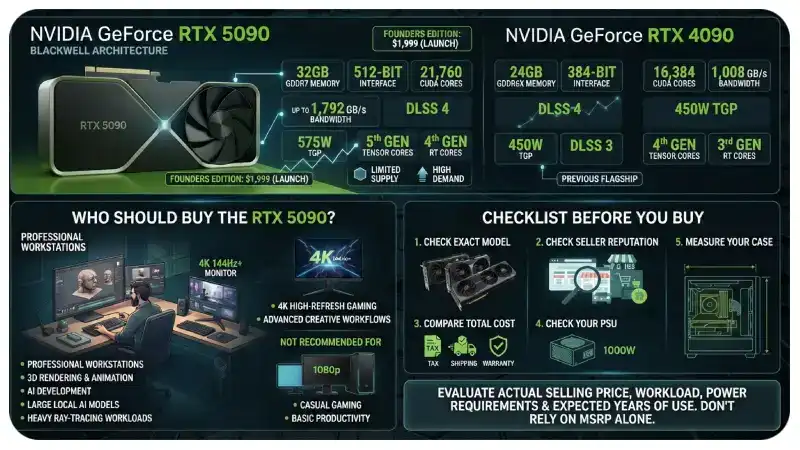
The NVIDIA GeForce RTX 5090 sits at the top of NVIDIA’s GeForce RTX 50 Series. Built on the Blackwell architecture, it targets gamers, creators, developers, and AI enthusiasts who want extremely high GPU performance.
However, performance is only part of the story. The nvidia geforce rtx 5090 price has changed significantly depending on availability, manufacturer, region, and current market conditions.
NVIDIA originally listed the Founders Edition at $1,999, but real-world retail pricing can be much higher. Recent U.S. market reports have shown RTX 5090 cards selling for several thousand dollars because of limited supply and high demand.
So, what does the RTX 5090 actually offer, and what should you check before buying one?
NVIDIA GeForce RTX 5090 Price
The official launch price for the RTX 5090 Founders Edition was $1,999 in the United States. NVIDIA’s marketplace lists the card with 32GB of GDDR7 memory and 21,760 CUDA cores.
That $1,999 figure is best viewed as the original reference price rather than a guarantee of what you will pay today.
In September 2026, market pricing has become much more complicated. Reports indicate that some U.S. RTX 5090 listings have reached $5,000 or more, while extreme third-party listings have gone considerably higher.
This difference matters when calculating value. Paying close to MSRP creates a very different buying decision from paying two or three times the launch price.
Why Is the RTX 5090 So Expensive?
Several factors can influence the final retail price:
- Limited inventory
- High demand from enthusiasts
- Demand for AI workloads
- Premium cooling designs
- Factory-overclocked models
- Regional taxes and import costs
- Third-party seller markups
For example, NVIDIA’s Founders Edition has a reference specification, while partner cards can use larger coolers, different power designs, and higher factory clocks.
The important lesson is simple: do not judge the card’s value from MSRP alone. Check the actual price of the specific model you plan to purchase.
RTX 5090 Specifications at a Glance
The RTX 5090 delivers flagship-level hardware across nearly every major specification.
| Specification | RTX 5090 |
|---|---|
| Architecture | NVIDIA Blackwell |
| CUDA Cores | 21,760 |
| VRAM | 32GB GDDR7 |
| Memory Interface | 512-bit |
| Boost Clock | 2.41 GHz |
| Tensor Cores | 5th Generation |
| Ray Tracing Cores | 4th Generation |
| AI Performance | 3,352 AI TOPS |
| Memory Bandwidth | Up to 1,792 GB/s |
| Total Graphics Power | 575W |
| Recommended System Power | 1,000W |
| PCIe | PCIe 5.0 |
| DLSS | DLSS 4 |
| Architecture | Blackwell |
NVIDIA confirms the 21,760 CUDA cores, 32GB GDDR7 configuration, 512-bit memory interface, 2.41 GHz boost clock, and 575W total graphics power.
The 32GB memory capacity also gives the card considerable headroom for demanding games, high-resolution creative projects, and AI applications.
Blackwell Architecture Explained
The RTX 5090 uses NVIDIA’s Blackwell architecture, which introduces major changes beyond simply adding more processing cores.
The GPU includes fifth-generation Tensor Cores for AI workloads and fourth-generation Ray Tracing Cores for demanding lighting and rendering effects. NVIDIA also supports DLSS 4 on the RTX 5090.
For everyday users, the practical benefit is more important than the architecture name.
Blackwell helps the RTX 5090 handle workloads that can overwhelm older graphics cards, especially when you combine high resolutions, ray tracing, AI features, and complex creative applications.
Gaming Performance
The RTX 5090 is designed for high-end gaming, particularly at 4K resolution.
If you have a 4K 144Hz, 240Hz, or similarly high-refresh display, the extra GPU power becomes much easier to justify. It also makes sense for gamers who want to use demanding ray-tracing settings without dropping to lower image-quality presets.
DLSS can further improve the experience by using AI-assisted rendering technologies. NVIDIA lists Super Resolution, Ray Reconstruction, Frame Generation, and Multi Frame Generation among the RTX 5090’s supported DLSS features.
A Practical Example
Imagine a gaming PC with:
- RTX 5090
- Modern high-end CPU
- 32GB or 64GB RAM
- NVMe SSD
- 4K high-refresh monitor
This type of system makes sense when the goal is maximum graphics performance rather than simply playing games at standard 1080p settings.
On the other hand, buying a $2,000-plus graphics card for a basic 1080p gaming setup would leave much of its capability unused.
32GB GDDR7: One of Its Biggest Advantages
One of the RTX 5090’s most important specifications is its 32GB of GDDR7 memory.
Modern games are becoming increasingly demanding. High-resolution textures, ray tracing, large game worlds, AI features, and content-creation applications can all increase memory requirements.
The RTX 5090 also provides a 512-bit memory interface, while NVIDIA lists memory bandwidth of up to 1,792 GB/s.
That bandwidth helps the GPU move large amounts of data efficiently.
For most traditional gaming today, 32GB is more than enough. Its larger value becomes clearer for professional workloads, AI experimentation, 3D rendering, and other memory-intensive applications.
RTX 5090 for AI and Content Creation
The RTX 5090 isn’t only a gaming graphics card.
Its large VRAM capacity and AI-focused hardware make it useful for tasks such as:
- Local AI models
- Image generation
- Video editing
- 3D rendering
- Animation
- CAD workloads
- Machine-learning experiments
- High-resolution content production
NVIDIA has highlighted the RTX 5090’s FP4 AI capabilities and reported major improvements for certain generative-AI workloads compared with the RTX 4090.
For creators, the extra VRAM can also reduce the need to constantly optimize projects around memory limitations.
Power Requirements You Should Not Ignore
The RTX 5090 is a very powerful GPU, and that power comes with substantial energy requirements.
NVIDIA lists a 575W Total Graphics Power and recommends a 1,000W system power supply under its reference configuration.
That means you should not buy the card first and worry about the rest of the PC afterward.
Before upgrading, check:
- Your power supply wattage
- PSU quality and PCIe compatibility
- CPU power requirements
- Case airflow
- Available GPU clearance
- Motherboard compatibility
- Cooling capacity
A high-end graphics card deserves a properly balanced system.
RTX 5090 Size and Case Compatibility
The reference RTX 5090 measures approximately 304mm long and 137mm wide, although partner models can be larger. NVIDIA lists the Founders Edition as a two-slot design, while actual add-in-card dimensions vary by manufacturer.
This is important because some premium RTX 5090 models use very large heatsinks.
Before ordering, measure your case rather than relying only on the GPU’s product name.
Also check whether front-mounted radiators, drive cages, or other components reduce available GPU space.
Is the RTX 5090 Worth Its Price?
The answer depends heavily on the price you can actually find.
At its original $1,999 MSRP, the RTX 5090 was positioned as an extreme flagship product. At several thousand dollars above MSRP, the value calculation changes substantially.
For example, someone building a professional workstation may benefit from the GPU’s large memory capacity and compute performance.
A typical 1080p gamer may gain far less from the upgrade.
This is why comparing the actual purchase price against your workload is more useful than simply asking whether the RTX 5090 is powerful.
RTX 5090 vs. RTX 4090
The RTX 5090 represents a substantial hardware change over the previous flagship.
NVIDIA lists:
- 32GB GDDR7 vs. 24GB GDDR6X
- 21,760 CUDA cores
- Blackwell architecture
- Fifth-generation Tensor Cores
- Fourth-generation Ray Tracing Cores
- DLSS 4
- Up to 1,792 GB/s memory bandwidth
NVIDIA’s own comparison data shows the RTX 5090 with significantly higher AI performance and memory bandwidth than the RTX 4090.
However, an RTX 4090 owner should consider the upgrade price carefully. If the existing system already handles the intended games and applications well, the upgrade makes more sense when the new card provides a meaningful improvement for a specific workload.
What Should You Look for When Buying an RTX 5090?
Don’t focus only on the cheapest listing.
1. Check the Exact Model
Different manufacturers offer different cooling systems, clock speeds, dimensions, and power designs.
2. Check Seller Reputation
A suspiciously cheap listing can create more problems than it solves. Recent reports have highlighted extreme third-party RTX 5090 prices and questionable online listings.
3. Compare Total Cost
Consider shipping, taxes, warranty, and other fees rather than looking only at the advertised GPU price.
4. Check Your PSU
A quality 1,000W-class PSU may be appropriate for a high-end configuration, depending on the complete system.
5. Measure Your Case
Premium RTX 5090 cards can have significantly different dimensions.
Who Should Buy the RTX 5090?
The RTX 5090 makes the most sense for users who have a specific reason to need extreme GPU performance.
It can be particularly relevant for:
- 4K high-refresh gaming
- Heavy ray-tracing workloads
- Professional video production
- 3D rendering
- AI development
- Large local AI models
- Advanced creative workflows
For casual gaming, basic editing, or lower-resolution displays, a less expensive GPU may provide enough performance without requiring such a large investment.
Final Thoughts on the NVIDIA GeForce RTX 5090 Price
The nvidia geforce rtx 5090 price is one of the most important parts of the buying decision because the card’s market price can differ dramatically from its original MSRP.
NVIDIA launched the Founders Edition at $1,999, while current market reports show that real-world prices can be substantially higher because of supply and demand.
The hardware itself is impressive: 21,760 CUDA cores, 32GB of GDDR7 memory, Blackwell architecture, advanced ray tracing, DLSS 4, and a 575W power target.
The smartest approach is to evaluate the actual selling price, your workload, power requirements, and expected years of use before purchasing.
If you need flagship-level gaming or professional GPU performance and can find an RTX 5090 at a reasonable market price, its specifications make it a serious high-end option. If the price is dramatically inflated, waiting for better availability or comparing alternatives may make more financial sense.