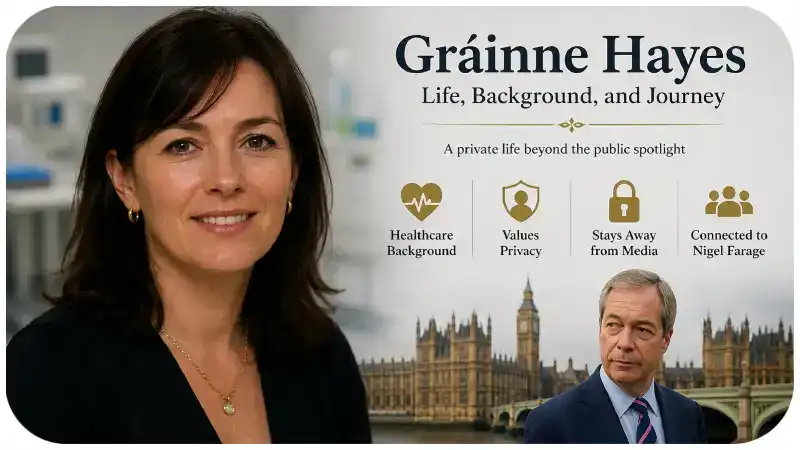
The name Gráinne Hayes is most commonly discussed in relation to British political figure Nigel Farage. However, despite this connection, she has consistently maintained a private lifestyle and has stayed away from media attention throughout her life.
Unlike public personalities who actively build careers in the spotlight, Gráinne Hayes follows a very different path. In fact, her life is defined by privacy, limited public exposure, and a focus on life outside political and media narratives.
Therefore, this article takes a careful, fact-based look at what is publicly known about her background, her connection to Nigel Farage, and why her name continues to attract online interest.
Early Life and Background
Publicly verified information about Gráinne Hayes’ early life remains limited. Nevertheless, she is widely understood to have Irish roots along with a background linked to the healthcare environment.
In contrast to public figures with documented entertainment or political careers, she has stayed a private individual. As a result, details such as her education, upbringing, and personal family history are not widely available in verified public records.
However, what can be reasonably stated is that her professional background is associated with healthcare support work. This field typically requires responsibility, discipline, and direct interaction with patients in structured medical settings.
Moreover, this type of work is often demanding because it requires emotional resilience and strong communication skills, especially in fast-paced clinical environments.
Connection to Nigel Farage
Gráinne Hayes became known to the public primarily through her marriage to British politician Nigel Farage, who is a prominent figure in UK and European political life.
Importantly, their marriage took place in the late 1980s, before Farage became widely recognized in politics. At that time, his career had not yet entered the public spotlight.
Later, their relationship ended in divorce in the 1990s. After the separation, Nigel Farage went on to become a well-known political leader. Meanwhile, Gráinne Hayes chose to remain outside public attention.
In addition, she did not move into media, politics, or public commentary roles after the marriage ended. Instead, she continued a private life away from ongoing political discussions.
Life After Separation
Following her divorce from Nigel Farage, Gráinne Hayes maintained a quiet and low-profile life. Unlike many individuals who are once connected to public figures, she did not pursue media appearances, interviews, or public-facing roles.
As a result, this decision clearly reflects a strong preference for personal privacy and separation from political visibility.
Furthermore, in today’s digital era—where personal histories are often widely circulated online—maintaining such privacy has become increasingly rare. Even so, her example shows that it is still possible to remain largely outside public discourse even when connected to a well-known figure.
Why Gráinne Hayes Attracts Public Interest
Generally, interest in Gráinne Hayes comes from curiosity about the early life of Nigel Farage and the people connected to him before his political rise.
However, it is important to understand that her public relevance is not based on her own public career or media involvement. Instead, it is based on her historical connection to a prominent political figure.
Consequently, this raises broader questions about how the internet treats individuals who are indirectly associated with public personalities:
- Should private individuals remain part of public online narratives?
- How much historical detail is appropriate when someone has chosen privacy?
- Where should the line be drawn between public interest and personal boundaries?
These questions matter more than ever in modern digital culture because even limited associations can create long-term online visibility.
Privacy in the Digital Age
Gráinne Hayes’ case highlights an important reality of modern digital life: privacy has become harder to maintain, especially for individuals connected to public figures.
However, her example also proves that privacy is still possible when it is actively maintained. In fact, she has remained largely absent from media coverage, interviews, and public commentary.
In this context, privacy serves several important purposes:
- It protects individuals from unnecessary public scrutiny
- It prevents misinformation or exaggerated narratives
- It allows people to continue normal personal and professional lives
- It minimizes the effect of public association with political or media personalities
Therefore, in an era dominated by social media and online archives, this level of discretion is increasingly uncommon.
Professional Background and Work Life
Although detailed records are not publicly documented, Gráinne Hayes is often associated with work in the healthcare environment.
Healthcare-related roles are typically structured and demanding. They focus strongly on patient care and support in professional settings.
In general, such work requires:
- Strong interpersonal communication
- Emotional stability in stressful situations
- Attention to detail
- Commitment to helping others in medical or care settings
Even though these roles often receive little public recognition, they remain essential to society and form the backbone of many healthcare systems.
Media Silence and Public Absence
One of the most notable aspects of Gráinne Hayes’ life is her complete absence from media platforms.
For example, she has not been publicly active in areas such as:
- Political commentary
- Television interviews
- Social media influence
- Public advocacy related to her former marriage
Although this absence is common for private individuals, it becomes more noticeable when someone is connected to a well-known public figure.
As a result, her silence has helped maintain a clear boundary between her private life and public political discussions.
Understanding Her Public Image
The public image of Gráinne Hayes is shaped almost entirely by secondary association rather than direct public activity.
This is an important distinction because many individuals become publicly known not through their own actions, but through relationships or historical connections.
In her case, since she has not made public statements or media appearances, her identity remains largely private and undefined in the public domain.
Therefore, curiosity exists, but verified information remains limited.
Lessons from Her Story
Gráinne Hayes’ life offers several important insights about media, privacy, and digital culture:
1. Not all connected individuals are public figures
For example, being associated with a well-known person does not automatically make someone a public personality.
2. Privacy can be intentional and effective
Even today, it is still possible to maintain a low public profile.
3. Public curiosity does not equal public entitlement
However, interest in a topic does not justify full exposure of private lives.
4. Historical associations should be handled responsibly
Therefore, accurate and respectful reporting is always more valuable than speculation.
Conclusion
Gráinne Hayes remains a private individual whose public recognition comes mainly from her past connection to Nigel Farage. Beyond this association, she has chosen a life away from media attention and public commentary.
Overall, her story is not defined by public appearances or media influence. Instead, it is defined by privacy, personal boundaries, and independence in a highly visible digital world.
In conclusion, her life highlights an important modern reality: even in an era of constant online exposure, some individuals can successfully maintain distance from public narratives—and that choice deserves respect.