Finding the Best Gaming Laptop in 2026: Top Picks & Buying Guide can be harder than it looks. Laptop makers now offer powerful RTX 50-series graphics, fast high-refresh displays, modern AMD and Intel processors, and a wide range of designs. The right choice depends less on having the biggest specifications and more on matching the hardware to the games you play, your budget, and how often you carry the laptop.
For shoppers searching for sosoactive, the goal should be the same: find a machine that delivers strong gaming performance without paying for hardware you will not actually use. This guide explains what to look for, which specifications matter, and how to choose between budget, mid-range, and premium gaming laptops in 2026.
What Makes a Gaming Laptop Good in 2026?
A gaming laptop needs to balance several components. A fast graphics card is essential, but it cannot work at its best if the laptop has weak cooling, limited memory, or a display that does not match its performance.
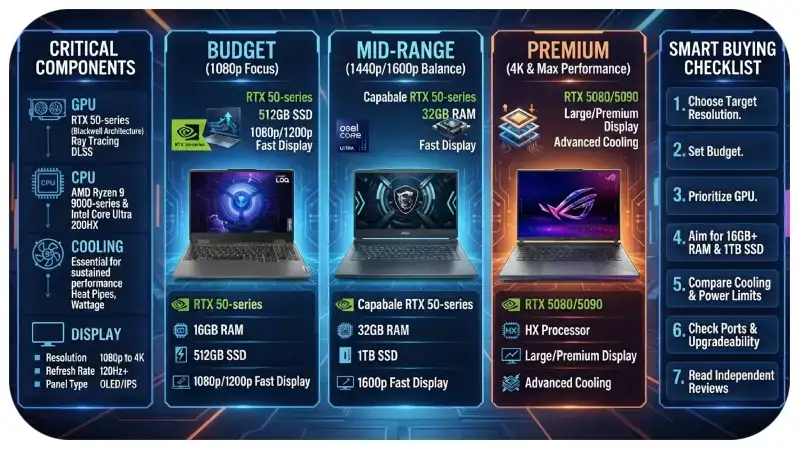
The major components to consider are:
- GPU: The most important component for demanding games.
- CPU: Handles game logic, background tasks, streaming, and productivity.
- RAM: Affects multitasking and helps modern games run smoothly.
- SSD: Provides fast boot times, game loading, and file transfers.
- Display: Determines resolution, refresh rate, color quality, and viewing experience.
- Cooling: Allows the hardware to maintain performance during long gaming sessions.
- Battery: Important if you also use the laptop for school, work, or travel.
- Build quality: Matters for durability and portability.
In 2026, NVIDIA’s RTX 50-series laptop GPUs are a major part of the gaming market, with Blackwell-based options designed for gaming and AI-powered features such as DLSS.
That does not mean every RTX 50-series laptop performs the same. Laptop manufacturers can configure GPUs at different power levels, so the exact laptop design matters alongside the GPU name.
Best Gaming Laptop in 2026: How to Choose the Right Class
Instead of looking for one laptop that is supposedly perfect for everyone, it makes more sense to divide gaming laptops into different performance classes.
Budget Gaming Laptops
Budget models are designed for gamers who mainly want solid 1080p performance without spending flagship-level money.
A good budget configuration should generally include:
- A modern dedicated GPU
- 16GB of RAM
- At least a 512GB SSD
- A 1080p or 1200p high-refresh display
- Effective dual-fan or equivalent cooling
Models such as the Lenovo LOQ and Acer Nitro families continue to appear in current gaming-laptop recommendations, with RTX 50-series configurations available in this segment.
The main compromise at this price level is usually build quality, display quality, storage capacity, or GPU power rather than basic gaming capability.
Mid-Range Gaming Laptops
For many gamers, the mid-range category offers a more balanced combination of performance and features.
This class is particularly attractive if you want to play modern AAA games while also using the laptop for school, work, video editing, or content creation.
Look for:
- 16GB or more RAM
- A capable RTX 50-series GPU
- A fast 1600p or similar display
- 1TB SSD storage
- Strong cooling
- A quality keyboard and trackpad
Current 2026 buying guides highlight machines such as the MSI Vector 16 HX AI and other RTX 5070/5080-class systems for shoppers seeking higher performance without necessarily moving to the most expensive flagship configurations.
Premium Gaming Laptops
Premium laptops are designed for people who want maximum performance, better screens, stronger construction, or a more refined portable workstation.
High-end models can feature RTX 5080 or RTX 5090 laptop GPUs, powerful HX-class processors, large displays, advanced cooling, and premium materials.
The trade-offs are straightforward: they cost considerably more and are often heavier. A flagship laptop also does not automatically provide better value for someone who mainly plays competitive games at 1080p.
sosoactive: Which GPU Should You Look For?
For gaming, the graphics processor usually deserves the largest share of your attention.
NVIDIA’s current laptop range includes RTX 50-series GPUs, with features built around the Blackwell architecture and technologies such as DLSS and ray tracing.
The practical approach is to choose the GPU according to your target resolution.
1080p Gaming
If you mainly play esports games or less demanding titles, an entry or mid-range dedicated GPU can be enough.
A high-refresh 1080p display can make more sense than spending extra money on a very high-resolution panel that the GPU struggles to drive.
1440p or 1600p Gaming
This is where a stronger mid-range GPU becomes attractive. A 1600p laptop display can provide a noticeable improvement in image detail while remaining more manageable than native 4K gaming.
Several 2026 buying guides specifically emphasize the importance of matching GPU power to display resolution rather than simply choosing the highest available screen resolution.
4K Gaming
4K gaming is demanding. If you want to play modern AAA games at very high settings, you need substantially more graphics power and may benefit from upscaling technologies.
For most laptop buyers, 4K should be treated as a premium feature rather than a requirement.
CPU: AMD vs. Intel for Gaming Laptops
The processor still matters, especially in games that depend heavily on CPU performance.
AMD’s Ryzen 9000-series mobile processors include high-performance HX chips. For example, the Ryzen 9 9850HX has 12 cores, 24 threads, and a configurable 55–75W TDP.
AMD also offers higher-end Ryzen 9 9955HX3D processors with 16 cores and 32 threads, aimed at demanding gaming and creator workloads.
Intel remains a major option as well. Its Core Ultra 200HX family targets high-performance laptops for gaming, content creation, and workstation workloads, with additional 200HX Plus models introduced in 2026.
Rather than choosing based only on the brand, compare the actual processor, cooling system, and complete laptop configuration.
For gaming, a powerful CPU paired with a weak GPU can be an inefficient use of your budget. In most demanding graphical games, GPU capability deserves greater attention.
How Much RAM and Storage Do You Need?
16GB RAM
For a gaming laptop in 2026, 16GB is a sensible starting point for a mainstream system.
It is enough for gaming plus ordinary background applications, although demanding multitasking can benefit from more.
32GB RAM
Choose 32GB if you regularly:
- Stream games
- Edit video
- Run virtual machines
- Use demanding creative applications
- Keep many applications open
- Want more headroom for future games
If the laptop allows memory upgrades, that can also make a lower initial configuration more flexible.
1TB SSD
A 1TB SSD is preferable for many gamers because modern games can consume significant amounts of storage.
A 512GB drive can work, but you may quickly find yourself uninstalling games to make room for new ones.
Before buying, also check whether the laptop provides a second M.2 slot. Expandable storage can be more useful than paying a large premium for a bigger drive at purchase.
Display Features Matter More Than You Might Expect
A powerful gaming laptop deserves a display that can actually show what its hardware produces.
Refresh Rate
A 120Hz or faster display provides a smoother experience than a standard 60Hz panel. Competitive players may prefer even higher refresh rates, especially for esports titles.
However, a 240Hz or 360Hz display is not automatically better for everyone. If your GPU cannot produce high frame rates in your games, you may get more value from better resolution, brightness, or color reproduction.
Resolution
Common choices include:
- 1080p: Easier to drive and suitable for budget systems.
- 1200p: A useful taller-screen alternative on many laptops.
- 1440p/1600p: Excellent balance for stronger gaming laptops.
- 4K: Best suited to premium systems and specific creative or visual workloads.
For many buyers, 1600p is a particularly interesting middle ground because it offers sharper visuals without imposing the same workload as 4K.
OLED vs. IPS
OLED panels can provide excellent contrast and deep blacks, while quality IPS displays can offer strong brightness, color accuracy, and often lower cost.
Do not choose based on panel technology alone. Check the specific laptop’s brightness, response time, refresh rate, color coverage, and reviews.
Cooling Is a Hidden Specification
Two laptops can contain the same processor and GPU but deliver different real-world results.
Why? Cooling.
Gaming laptops generate substantial heat under sustained loads. A thicker chassis may provide more room for fans, heat pipes, vapor chambers, and airflow.
When comparing two laptops with similar specifications, look for independent testing that measures sustained performance and temperatures.
This is also why GPU wattage matters. Current 2026 laptop buying guides warn that the same GPU model can perform differently depending on its power configuration.
Do not judge a laptop entirely by the name printed on its GPU.
Battery Life and Portability
Gaming performance and battery life often pull in opposite directions.
A powerful CPU and dedicated GPU consume considerable power during gaming. Most gaming laptops therefore make the most sense when plugged into AC power for demanding games.
If you travel frequently, consider a 14- or 16-inch model rather than a huge desktop-replacement laptop.
Compact gaming laptops can still offer serious performance. The ASUS ROG Zephyrus G14, for example, continues to appear in 2026 recommendations for buyers seeking a smaller gaming machine.
If portability is not important, larger 16- and 18-inch systems can provide more room for cooling and bigger screens.
Other Features Worth Checking
Before buying, look beyond CPU and GPU specifications.
Keyboard
Check key travel, layout, lighting, and whether the arrow keys and function row are comfortable for you.
Ports
A good gaming laptop may include:
- USB-A
- USB-C
- HDMI
- Ethernet
- Headphone jack
- High-speed USB-C or Thunderbolt/USB4, depending on platform
Port selection becomes especially important if you plan to connect an external monitor, gaming mouse, headset, Ethernet cable, or storage drive.
Webcam and Microphones
If you attend classes, meetings, or stream content, webcam quality matters more than it does on a laptop used exclusively for gaming.
Upgradeability
Check whether the RAM and SSD can be replaced or expanded. A laptop with accessible upgrades can remain useful for longer.
Common Gaming Laptop Buying Mistakes
Even experienced shoppers can focus too much on headline specifications.
Buying the Most Expensive GPU
A flagship GPU is unnecessary if you mostly play lightweight games at 1080p.
Ignoring GPU Power Limits
Two laptops with the same GPU name can have different performance because of power and thermal configurations.
Choosing 4K Just for the Number
Higher resolution requires more graphics power. A well-balanced 1600p display can be a better match for many gaming systems.
Buying Too Little Storage
A 512GB SSD may fill quickly once you install several large games.
Forgetting the Charger
Powerful gaming laptops often come with large chargers. If portability matters, consider the complete travel setup rather than laptop weight alone.
Ignoring Reviews
Specifications cannot tell you everything. Independent testing can reveal fan noise, temperatures, battery behavior, display quality, and sustained gaming performance.
A Simple Buying Checklist
Before purchasing your next gaming laptop, check these points:
- Choose your target resolution.
- Set your maximum budget.
- Prioritize the GPU.
- Aim for at least 16GB RAM.
- Prefer a 1TB SSD if your budget allows.
- Compare GPU power limits between models.
- Check display refresh rate and image quality.
- Research cooling and sustained performance.
- Check ports and upgrade options.
- Read independent reviews before ordering.
This approach is more reliable than simply buying the laptop with the longest specification list.
Is a Gaming Laptop Worth Buying in 2026?
For many gamers, yes—especially if you need one computer for both gaming and everyday work.
A desktop still offers advantages in upgradeability and often provides more performance per dollar. But a gaming laptop combines a screen, keyboard, battery, and PC hardware into one portable machine.
The 2026 market also gives shoppers more choices across different performance levels. Current testing and buying guides cover everything from relatively affordable RTX 50-series systems to premium machines with flagship GPUs.
The key is to avoid paying for features you do not need.
Conclusion
The right sosoactive gaming laptop is not necessarily the one with the highest specifications. It is the one whose GPU, CPU, display, cooling, storage, and portability fit the way you actually play.
For budget buyers, prioritize a capable GPU, 16GB of RAM, and a fast display. Mid-range shoppers should look for a balanced system with stronger graphics, 1TB storage, and good cooling. Premium buyers can consider RTX 5080 or RTX 5090-class machines, but should still compare thermals, display quality, weight, and overall design.
In 2026, the smartest approach is to compare the complete laptop, not just its processor or graphics card name.