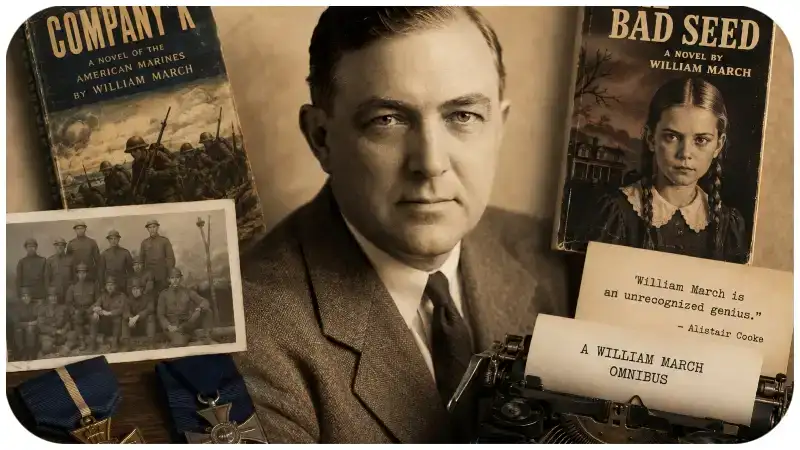
William John March, widely known in literary history as William March, is regarded as one of the most psychologically insightful American writers of the twentieth century. His work bridges war literature, Southern fiction, and psychological realism in a way that still feels modern today.
Best known for Company K and The Bad Seed, March built a reputation for writing about human behavior with rare honesty. His fiction does not rely on glamour or heroism. Instead, it explores trauma, moral conflict, and the hidden complexity of ordinary people.
Although he never achieved the mainstream fame of some contemporaries during his lifetime, his reputation has steadily grown. Today, critics and scholars recognize him as a major voice in American literary history.
Early Life and Family Background
William John March was born William Edward Campbell on September 18, 1893, in Mobile, Alabama. He grew up in a large household as one of 11 siblings, an environment shaped by financial pressure and limited resources.
Because of economic hardship, March began working at the age of 14 to support his family. This early responsibility shaped his worldview and later influenced the grounded realism found in his fiction.
Despite limited formal schooling, he pursued education with determination. He attended preparatory studies connected to Valparaiso University and later studied law at the University of Alabama. However, financial difficulties prevented him from completing a degree.
These early experiences—poverty, responsibility, and self-education—later became central emotional foundations in his writing.
Military Service in World War I
In 1917, he enlisted in the United States Marine Corps during World War I. He served in combat zones in France, where he experienced the harsh realities of modern warfare.
His service was highly distinguished. He received several major military honors, including:
- Distinguished Service Cross
- Navy Cross
- French Croix de Guerre
These awards placed him among the most decorated American Marines of World War I.
However, the psychological impact of war stayed with him long after his service ended. This experience deeply influenced his writing, especially his focus on trauma, fear, and moral uncertainty.
Business Career and Early Writing Path
After returning from the war, March joined the Waterman Steamship Corporation, where he built a successful business career. He eventually rose to an executive-level position.
While working full-time, he continued writing fiction in his spare time. This dual life—businessman by day, writer by night—helped him develop discipline and a unique perspective on human behavior.
His early short stories began appearing in respected literary magazines, slowly establishing his reputation as a serious writer.
Company K: A Breakthrough in War Literature
Published in 1933, Company K marked William March’s major literary breakthrough.
The novel draws directly from his wartime experience and presents World War I through 113 interconnected narratives. Each chapter is told from a different soldier’s perspective, creating a fragmented but powerful view of war.
Instead of focusing on heroism, the novel highlights confusion, fear, and emotional breakdown.
Why Company K Matters
- Realistic portrayal of war trauma
- Multi-perspective storytelling structure
- Strong psychological realism
- Anti-war thematic approach
- Deep emotional authenticity
Today, Company K is considered one of the most important American war novels of its era.
Reedyville: March’s Fictional Southern World
William March created a fictional Southern setting called Reedyville, which appears across several of his works.
Similar to other literary fictional counties in American literature, Reedyville serves as a recurring backdrop for exploring:
- Family conflict
- Social class divisions
- Moral tension
- Southern identity
Works such as Come in at the Door and The Tallons use Reedyville to build a connected fictional universe grounded in realism.
This setting allowed March to explore long-term social and psychological themes across multiple stories.
Literary Style and Major Themes
March’s writing is defined by psychological depth and moral complexity.
Human Psychology
He portrayed characters as layered individuals shaped by experience, trauma, and environment.
War and Trauma
His fiction often reflects the lasting emotional damage caused by combat.
Moral Ambiguity
March avoided simple “good vs evil” storytelling. His characters often live in moral gray areas.
Southern Social Reality
His works reflect class structure, family pressure, and cultural identity in the American South.
This combination of themes gives his work long-term academic and literary relevance.
The Bad Seed: A Landmark in Psychological Fiction
In 1954, March published The Bad Seed, his most commercially successful novel.
The story follows Rhoda Penmark, a child whose outward innocence hides deeply disturbing behavior. The novel challenged traditional assumptions about childhood innocence and morality.
Cultural Impact
- Broadway adaptation success
- Multiple film versions
- Major influence on psychological thriller genre
- Continued academic study in psychology and literature
The Bad Seed remains one of the most influential psychological suspense novels in American fiction.
A William March Omnibus and Critical Recognition
After his death, March’s literary importance continued to grow through posthumous publications.
One of the most significant collections is A William March Omnibus, which brought together key works from his career. This collection helped introduce his writing to new generations of readers.
The introduction by Alistair Cooke, who referred to March as an “unrecognized genius,” played an important role in shaping his critical reputation.
Today, the omnibus is widely regarded as an essential entry point for understanding his literary range and psychological insight.
Achievements and Literary Impact
William John March’s achievements span both military and literary fields:
- A highly decorated Marine of World War I
- Acclaimed novelist and short story writer
- Recognition for psychological realism in fiction
- Influence on war literature and modern thrillers
- Continued academic study in American literature
His work gained greater recognition after his death, particularly among literary critics and scholars.
Conclusion
William John March’s life reflects resilience, discipline, and deep artistic insight. From a childhood as one of 11 siblings to early work at age 14, from military service in World War I to a business career at Waterman Steamship Corporation, his journey shaped the emotional depth of his fiction.
Through Company K, The Bad Seed, and his Reedyville stories, March explored the complexities of human psychology with rare honesty. His writing continues to influence modern literature, especially in war fiction and psychological storytelling.
Today, William John March stands as a powerful example of how lived experience can transform into lasting literary legacy.
For information, visit our site daily.